
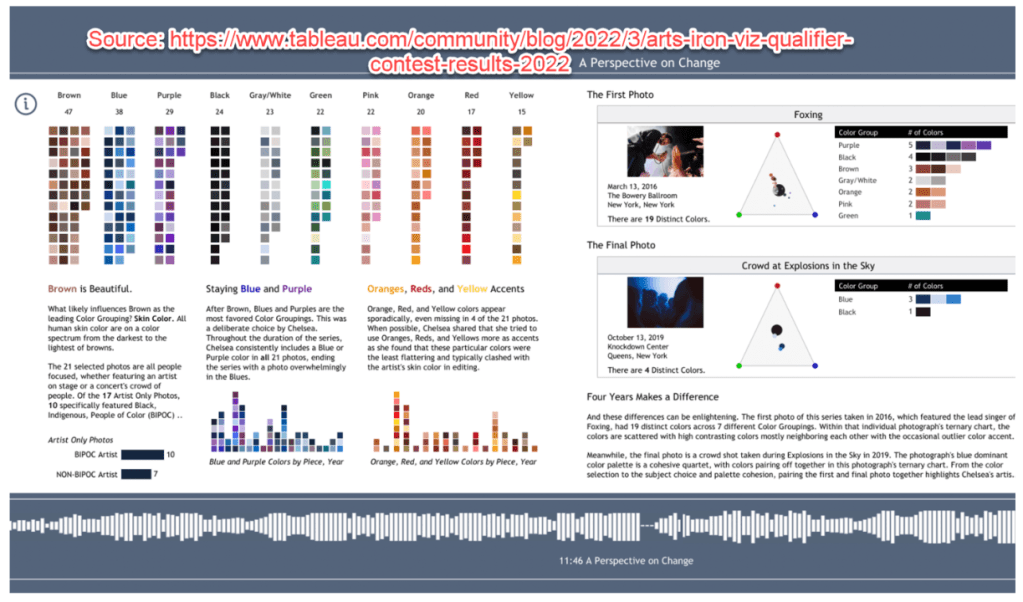
The Tableau Iron Viz competition has me thinking about how consulting hourly rates suffer from one of the major flaws of other cost plus pricing schemes — they automatically pass along productivity gains to the buyer.
Iron Viz is a competition where designers are all given the same structured and cleaned dataset with an analytics prompt and asked to build out an interpretation of that data in Tableau. They are judged on the Design, Storytelling and Analysis they create. In the final round of the Iron Viz competition 3 finalist create a Viz in 20 minutes while an audience watches their process in real-time, the so-called Iron Chief equivalent of dashboard design.
The 3 finalists are always exceptionally creative, thoughtful and artistic. What they accomplish in 20 minutes would easily take most analysts a week of deliberation and googling. If you look at salaries for data analysts working in Tableau they are wide ranging from as low as roughly $10USD/hour to over $300.
Some data analyst do their own data cleansing and ETL work, some have business consulting, project management or domain experience — a big range of skills and experience which generally gets boiled down to an hourly rate. This rate is intended to account for differential value in how much supervision and explicit requirements the worker needs for their task as well as how valuable the Viz will be within the organization commissioning it.
Like all other professions Tableau developers and those who hire them have to determine if a project based (or outcome based) rate makes more sense or hourly rates would be better. (Let’s ignore salaried employees for now).
Fixed Fee / Project & Deliverable or Outcome based fees make sense when the scope is fixed and the worker has very good knowledge of how much time and effort they need to delivery the scope. Estimates for this type of work may be build from the bottom up by estimating time for each activity required for total completion, or from the top down by reviewing work trends of how much effort similar projects have required in the past or they could be priced based on an understanding of a project’s value to the consumer along with competitive alternatives.
Businesses like these types of agreements because they are easier to budget for. Upside goes to the worker if things go more smoothly/quickly than expected, but there is risk that margins will suffer if unexpected obstacles crop up.
Time & Materials – Hourly rates make sense when the scope is more flexible or there are dependencies on other folks in the process such as those sourcing the data or providing business context and requirements.
Iron Viz is a crazy situation akin to pricing at a utility where the marginal cost of time and materials approach $0 — 20 minutes and the use of a companies existing Tableau license. Its an extreme example of where the worker can deliver tremendous value and if they were working for an hourly rate they would be passing on their efficiency directly to the customer. This would incentivize them to work at a way less frenzied pace.
If operational efficiencies or manufacturing cost reductions are like-wise passed along to consumers through cost plus pricing then the only impetus for improvement is competition rather than margins.
Iron Viz is a good example of the perverse incentive to drag your feet that hourly fees create in consulting.
 Carragee Consulting
Leave a comment