
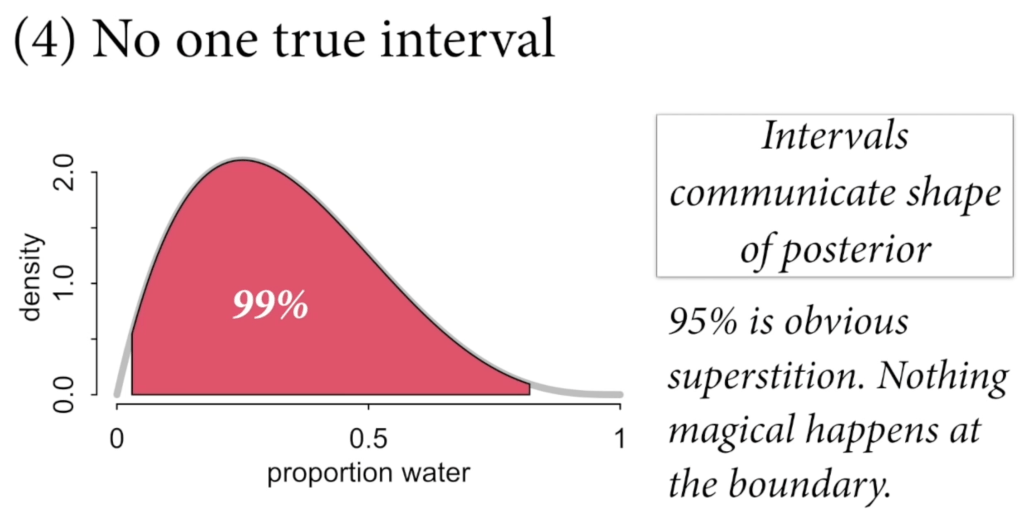
A big focus of lecture 2 of Richard McElreath’s course Statistical Rethinking is that in Bayesian analysis you may report some summary measures such as intervals within the posterior.
He points out that you could create an infinite number of intervals around different centers (Mean, Median, etc) and that the method doesn’t dictate which central point or interval is most logical to present, the context of the analysis does.
In Bayesian analysis the area under the curve (shown above) represents a normalized probability of 1 — something will happen and the question is what is the likelihood of each potential outcome? The entire shape of the distribution is used throughout your analysis, not just a point of maximum likelihood or a min or max value or the boundaries of an arbitrarily set confidence interval.
In the example from this lecture McElreath is asking if an asteroid hit the earth, what is the probability it will hit water (vs land.) Since the earth’s surface has both water and land the probability is somewhere between 0-100%. — any more specific knowledge you have of the % of surface covered each way could be used to inform the prior estimate at the outset of analysis.
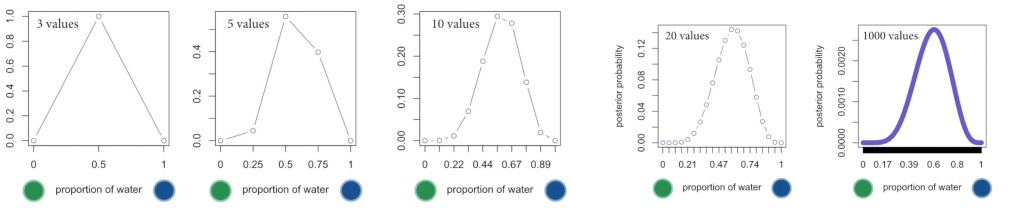
He gives the R code to play with various prior probabilities and test cases to redraw the posterior distribution curve and see how additional tests can benefit the distribution to a point. Overall this lecture does a great job of allowing this concept to be viscerally understood through trial and error and distilling the concept into such a simplified example.
Grid approximation in action:
 Carragee Consulting
Leave a comment