
The geocentric model of the solar system is “mechanistically wrong”, but still predictive of where the planets will appear against the backdrop of the far away stars.
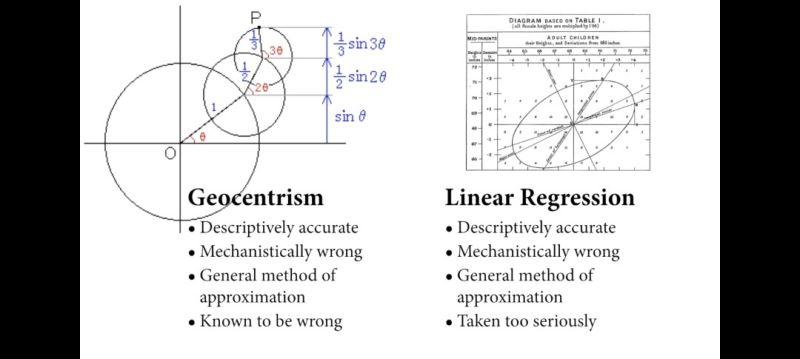
In Statistical Rethinking, McElreath (image credit) shows how the geocentric model of the solar system and linear regression applied in analytics can be similarly predictive without being accurately explanatory of the underlying phenomenon they are being used on.
I was rewatching lecture 3 right after rereading the Kipling poem “If” and thinking about the line:
“If you can bear to hear the truth you’ve spoken
Twisted by knaves to make a trap for fools,”
and thinking this describes the job responsibility of data analysts everywhere — you are Capernicuses or Galileos of the business world.
So much of what you seek to deeply understand is over simplified and truncated to the point of being misleading in a ppt deck or cut down to sound bites for a press conference and yet you soldier on pursuing methods of communication that will do battle with the received wisdom and assumptions of decision makers.
Sometimes we don’t care “why” things happen as long as we can predict them — like rain on your bike ride. Sometimes the “why” is absolutely essential to prediction, especially if there is a causal shift or exogenous factor that the erroneous model can’t incorporate.
I don’t have a conclusion here, just thinking out loud and hoping everyone reads “If’
 Carragee Consulting
Leave a comment