
My property taxes are higher than my neighbors
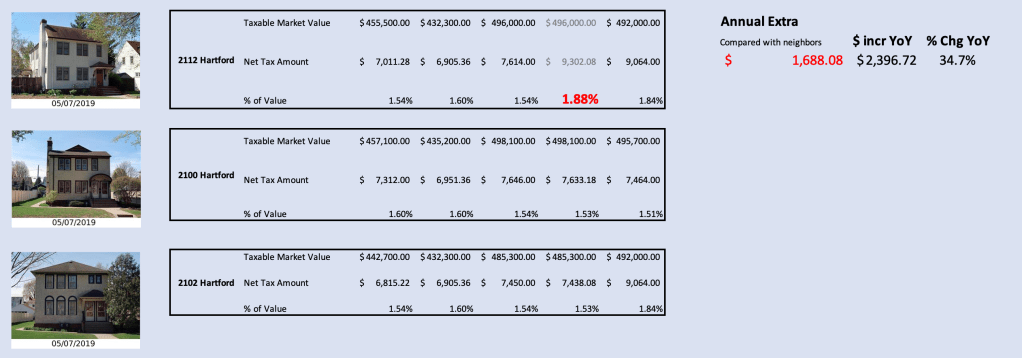
Last year my property taxes went up 34.7%
I’m paying ~$1700 more annually than the two neighboring properties which are almost identical, also 2400 sq ft up/down duplexes with detached 2 car garages.
Price variation on this level is not supposed to exist within the same county, so I’m contesting it tomorrow, but it is taking time and energy and the result is uncertain.
In other contexts, price variation is entirely expected and intentionally implemented under the economic concept of “price discrimination”, carried out with strategic customer and product segmentation.
One way you can understand price or cost variation is using Coefficient of Variation metrics which is the standard deviation in unit amount divided by the group average. This metric normalizes variation across groupings which can be priced is hugely varying nominal amounts. Using it resulting in an index of variation.
When Coeff of Var is high its a great diagnostic tool to look for micro-segments, data errors and potential at risk accounts/customers.
In this sample of 3 the Coefficient of Variation is 15% in 2023 tax amount for essentially the same Tax Assessed Property Value Amount
Std Dev ($1180)/Avg ($8124).
The key to using this comparison metric effectively is to ensure that your grouping/summarization level is conceptual relevant, not just an arbitrary product or customer hierarchy level that doesn’t align with any price or cost similarity expectation.
 Carragee Consulting
Leave a comment