
Matthew Roche, 2021
Check out his awesome blog: BI Polar
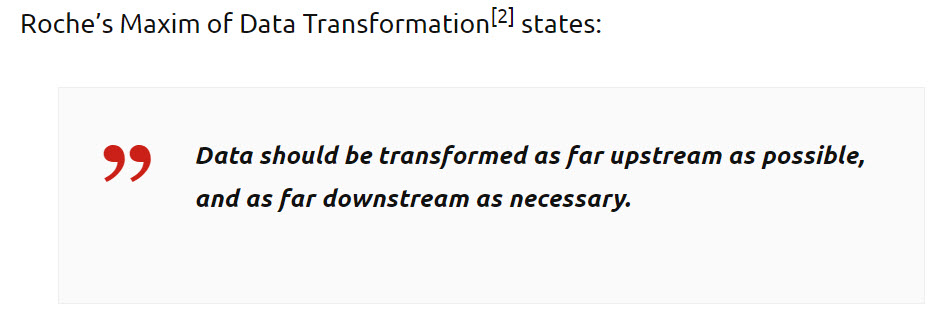
Thanks to Danil Z who brough this maxim to my attention a few months back on Linkedin.
Its a succinct way of showing data maturity.
Listening to Fundamentals of Data Engineering, by Joe Ries & Matt Housley, I keep coming back to the chapter on what roles are needed to enable analytics and how those change by org size, data volumes and maturity.
As someone who put an immense amount of time into learning Excel and now Power query, Tableau prep and basic SQL I can often hack together ad hoc data sets for consulting.
If my goal on a project extends past diagnosing some operations problems and I want to leave behind the monitoring tool I have to work with the in-house teams to understand their tech stack.
As desktop applications get more powerful decentralized teams can hack their way to quick answers, but they inadvertently contribute to many similar sounding metrics being created and to distrust of reporting.
Semantic layer tools, data lineage and cataloging are meant to bridge the gaps of some these issues, but the fundamental tradeoffs quick-cheap-repeatable-trustworthy don’t have one optimal tech stack or org structure solution.
Each role within the analytics process is making a determination of how far up the data chain they can impact to make the solution as robust and quick as possible.
For now, as an analyst you gotta learn basic DAX and SQL because there will always be upstream blockers .
 Carragee Consulting
Leave a comment